यथार्थ झूठ है, कल्पना सच है।
Reality is the lie; imagination, the truth.
— Vinod Kumar Shukla
Two men who never met. One writes about the multiverse from Oxford; the other writes Hindi novels from a small town in Chhattisgarh. They share a thesis almost nobody holds at once: the universe is unbounded, a finite mind can reach all of it, and the route there runs through imagination — not observation.
The Cramped Room
Vinod Kumar Shukla's most famous novel, Deewar Mein Ek Khidki Rehti Thi — A Window Lived in the Wall — opens onto an unremarkable life: a junior lecturer, a rented room, a wife. The window in the title looks out onto a forest that should not be there. The forest may be finite. The looking is not.
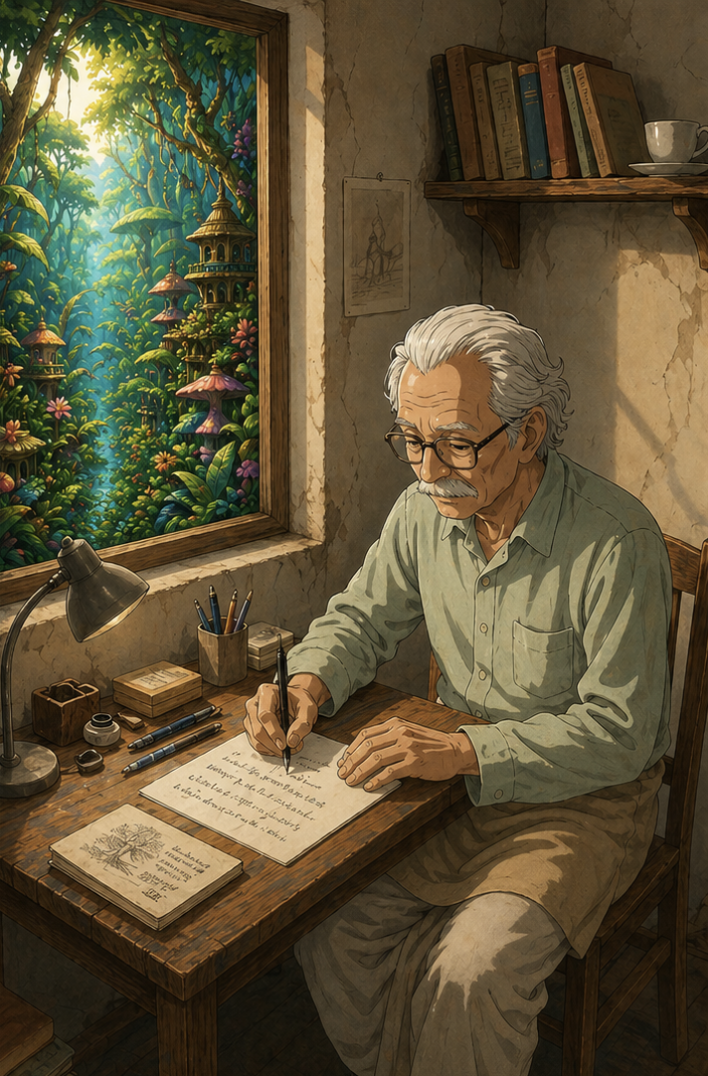 खिड़की · a window in the wall
David Deutsch's The Beginning of Infinity makes the formal version of the same claim. A sufficiently general explanation, once we have it, contains no internal stopping point. Nothing in physics, biology, or epistemology says we will eventually run out of things to understand. The room may be small, but the window is not.
The two arrive at the same place from opposite directions. Deutsch starts from the cosmos and works inward. Shukla starts from a window and works outward. They meet where the size of the container stops mattering.
Imagination as Method
It sounds like mysticism. It is not. In the Popperian tradition Deutsch carries, this is the literal mechanics of science.
Knowledge does not come from looking at the world. It comes from making a conjecture — a guess, an imagined explanation — and then submitting it to reality for refutation. The world cannot tell you what it is until you first guess. Yataarth, the world as it presents itself, does not contain its own theory. Kalpana, what the mind invents and sends back to test against it, does.
Shukla's characters begin from the same move — imagination first, world second. A man owns a forest because he has imagined himself into it. A husband finds his wife at home by deciding, on the walk back, what she will be doing when he arrives — "वह जब घर लौटता था तो रास्ते में ही तय कर लेता था कि उसकी पत्नी क्या कर रही होगी" — he would decide on the way home what his wife would be doing.
Here the two part company, and it is worth being honest about where. For Deutsch, reality keeps the final veto: the conjecture is offered up to be refuted, and most are. For Shukla, the veto is suspended — imagination does not merely precede the world, it reshapes it. One is epistemology, the other closer to grace. But the shared premise survives the split: the real becomes legible only after the mind has projected something onto it. Without the conjecture, there is no observation to make.
The Strange and the Connected
The convergence is not a coincidence. Both arrive at strangeness because they take the same premise seriously: if the mind's reach is unbounded, then the world the mind discovers cannot be the one common sense expects.
Deutsch's branching universes, computational equivalences, evolution operating on knowledge itself — these are what you get when you follow explanation past the horizon of intuition. Shukla's porous line between thought and weather, his trees that think and windows that keep company — these are what you get when you follow a sentence past the horizon of realism.
The method differs; the destination is the same. The familiar world is a compression artifact. Both insist the uncompressed version is stranger and more connected than the everyday one, and that fidelity to it is not mysticism but accuracy.
Optimism by Construction
Deutsch's principle: all evils are caused by lack of knowledge, and all problems are soluble given the right knowledge. This is not optimism as sentiment; it is optimism as epistemology.
Shukla arrives at the same place through fiction. His characters never despair because they never accept the premise that would make despair rational — that the walls define what is possible. A man walks through his own neighborhood and sees it as if for the first time, not because anything has changed but because his attention has.
The junior lecturer in the cramped room does not dream of a larger room; he discovers that the room he has contains a forest. This is not denial. It is a refusal to let the observable exhaust the real.
The sources are different — one philosophical, one moral — and the conclusion is identical. The future is not closed. The room is not the world.
Deutsch uses physics to argue that a finite mind has unbounded reach. Shukla uses a paragraph about a man's shirt to argue the same thing. The methods could not look more different. The claim is the same: there is more inside a single human life than the world will admit, and the way you find it is by imagining it first.