— Charlie Munger
Position Sizing
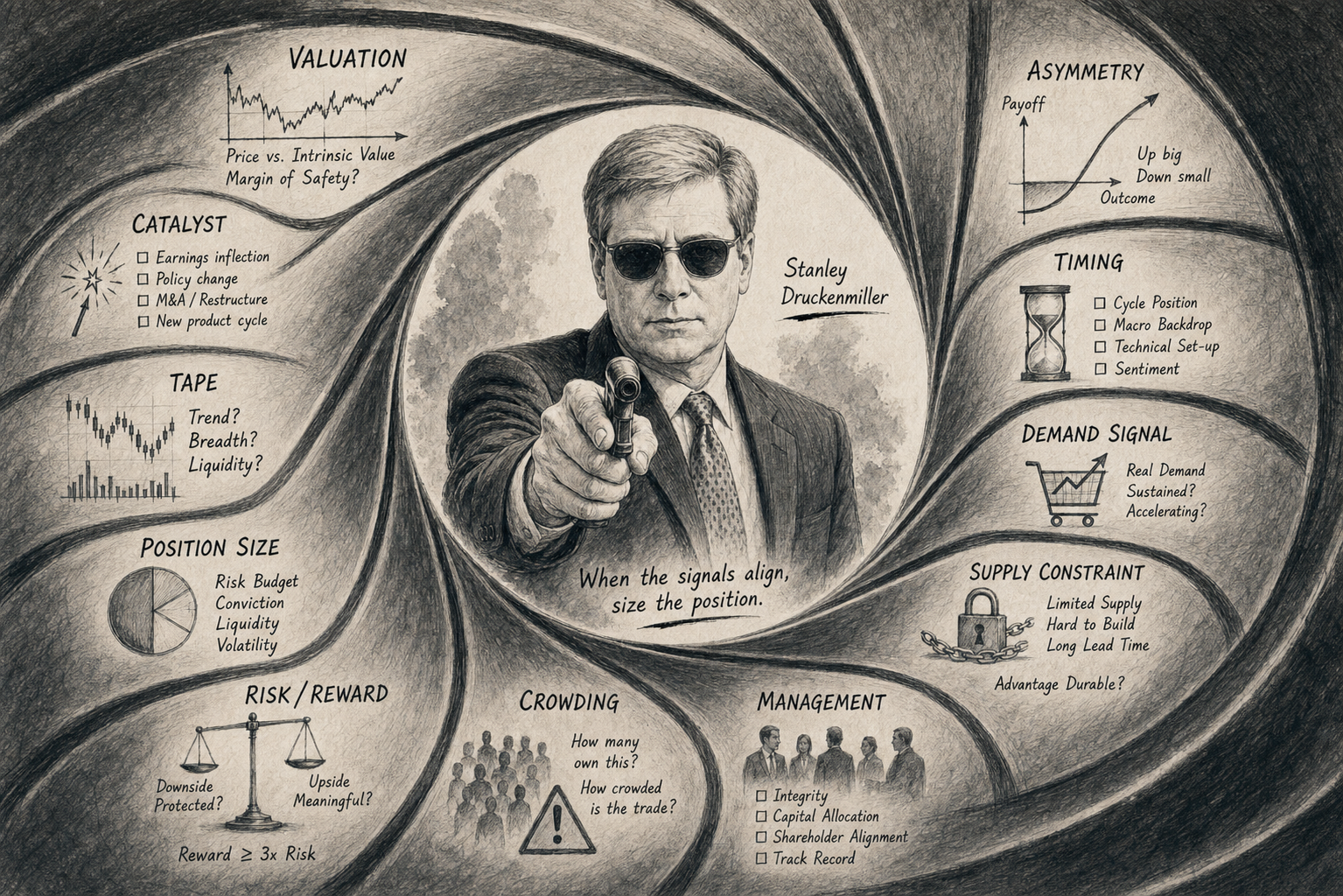
Most investors diversify their conviction away: they find a mispricing, believe in it deeply, then allocate a standard two percent of capital as if belief and sizing were unrelated. Position sizing means calibrating capital to conviction, and Druckenmiller inverts the default: when conviction is highest and the risk-reward is most asymmetric, concentration is not bravado; it is the point.
How do you get better at this calibration? You build an honest feedback loop. Keep a decision journal that records your conviction at the moment of allocation, before the market outcome has a chance to rewrite your memory.
Over time, the journal reveals the gap. Did you under-allocate to your best ideas out of fear? Did you over-allocate to mediocre ones out of impatience or boredom? Calibration is the slow work of making capital follow clarity, then training yourself to bear the volatility that concentration brings.
Druckenmiller has a name for the faculty this trains. He calls himself good at one nebulous thing — "pulling the trigger." The vagueness is the point. Trigger-pulling is the act of collapsing a dozen half-legible signals — the macro regime, the rate path, credit spreads, a currency dislocation, AI timelines, how the rest of the market is positioned — into a single decision: commit, and at what size. No model weights these for you. The edge is not in any one input; it is in the triage, and in the nerve to act once it resolves.
But concentration without flexibility is ruinous. The hidden variable in sizing is malleability: when disconfirming evidence arrives, how quickly can you temper conviction and downsize? The principle is "Strong opinions, loosely held." If you size a position heavily because the thesis is strong, you have to cut that size the moment the thesis fractures. A portfolio should be a liquid reflection of what you now understand, not a monument to what you once believed.
The sizing visualization above shows the tradeoff plainly: undersize and you protect yourself at the cost of compounding; oversize and you flirt with ruin. The well-sized path marries concentration with survival.
But no Kelly criterion saves you from uncertain inputs. You learn to size positions the way a pilot learns to land — by overshooting and undershooting until the feel is in your hands.
On Waiting
Ninety-nine percent of the time, you make money by waiting.
Do you know how to wait? The cost of the bias to act is far higher in investing than in almost any other domain. In most professional contexts, action is rewarded — ship faster, iterate, move. In investing, the reward structure is inverted.
Most of the return is generated by doing nothing for long stretches. The longer your holding period, the more of your return comes from patience, and the more destructive premature action becomes.
The difficult thing is not finding a 10× opportunity. The difficult thing is not selling when you have 10×'d.
And that is why you must know what you are buying — not just the ticker, but the business: what it is worth today, what it could be worth across the various branchings of the universe. If you understand the terminal valuation landscape, you can distinguish between this has gone up a lot and this is now overpriced. Without that understanding, every large gain triggers the same instinct: take profits. And taking profits on a position that still has a 3× from here is one of the most expensive mistakes in investing.
Waiting has a harder companion problem, though: knowing what is worth the wait. On a long enough timeline almost everything is cyclical, and the dispersion between the winners of one decade and the next is savage. Line up the top constituents of any major index across fifty years and the churn is the whole story — leaders become laggards, and most of the names simply disappear. Patience compounds only when it is aimed at something that survives the turn of the cycle; aimed at the wrong thing, it just locks you into a fading era.
A few themes, though, run secular rather than cyclical. The steady rise of technology's weight in the S&P 500 is the cleanest example — a multi-decade re-rating, not a rotation that mean-reverts. The question worth sitting with is which themes play that role over the next few decades. Semiconductors? Energy? Space? Get that call right and waiting does the rest of the work; get it wrong and no amount of patience redeems it.
Market Efficiency
Two propositions that sound contradictory but are not:
Markets are not immediately efficient. Prices take time to reflect information. Behavioral biases, institutional constraints, information asymmetry, and the mechanics of capital flow all open windows where price diverges from value. These windows are the entire basis for active investing.
Markets are eventually efficient. Over sufficient time, prices converge on fundamentals. Mispricings get arbitraged. Narratives give way to earnings. The pull of fair value is relentless, even when the path to it is circuitous and violent.
the gap between eventually and immediately is where returns live.
The ASI Endgame
A thought experiment. Grant three assumptions: Artificial Superintelligence arrives, it is rational, and it has access to capital. Markets would become immediately efficient. The gap between eventually and immediately — the very gap the last section located returns in — collapses to zero.
The assumptions may fail. The point is what the experiment exposes about the present: every edge you hold exists because your counterparty's model of the world is incomplete. Incompleteness is the resource you harvest — and the one AI depletes, not overnight, but on a curve.
This is not only a forecast; a version of it has already run. Cigar-butt investing — Graham's discipline of buying a business for less than its liquidation value, for one last free puff — is effectively dead. The gross dislocations it fed on are now screened, arbitraged, and repriced almost as soon as they surface; cheap computation and near-universal information absorbed them inside a single generation. What once rewarded years of patient ledger-reading, the market now resolves in days. AI is that same force with the dial turned up — widening the class of inefficiencies that vanish on contact and compressing the time-to-absorption toward zero. The ASI endgame is only the far limit of a curve we are already on.
Trace it past the first order. When analysis is free and universal, capital stops paying for it: research fees compress toward zero and the analyst's franchise evaporates. Edge migrates to what an intelligence cannot legally or physically reach — private information, relationships, regulatory position, operational control, and simply being early to the compute itself.
Further out, the system inverts. When every participant runs a convergent model, the market is efficient and brittle: priced identically, everyone crowds and de-risks in lockstep.
The last durable trade may not be choosing assets at all, but owning the intelligence and the energy that manufacture the efficiency — the meta-asset that prices everything else.
On the Unprecedented
"History doesn't repeat, but it rhymes" is the favorite aphorism of every market pundit, and it survives the overuse because it is mechanically true. A crisis never reassembles in the same configuration twice — the cast, the trigger, the leverage, the policy backdrop are always new. But the system is built of subsystems, and the subsystems rhyme. A bank run in 2023 is not a bank run in 1907, yet the reflex underneath — funding flees the instant confidence cracks — is the same subroutine running on newer hardware.
So the way to underwrite an unprecedented event is not to hunt history for a match; there won't be one. It is to decompose the event into mechanisms — a liquidity spiral, a crowded unwind, a duration mismatch, a reflexive feedback loop — and price the parts you recognize. Each mechanism carries its own precedent, its own base rate, its own tell. What survives the decomposition is the genuinely novel residue: the part with no analogue and nothing to lean on. That residue is where you size down, not up — you can reason about the rhyming parts, but the truly new part is uninsurable, and pretending otherwise is what turns a drawdown into a wipeout.
The unprecedented is rarely novel all the way down. It is an unfamiliar arrangement of familiar parts — and the edge is in recognizing the parts faster than the crowd recognizes the whole.
Three Things
You should understand three things to make money:
- Eventual valuation. What is this asset worth at terminal state? Not what the market says today — what does the math say about the steady-state cash flows, market size, or replacement cost?
- The nature of the gap between current and eventual valuation. Is the gap driven by ignorance, by time preference, by structural constraints, or by legitimate uncertainty? The nature of the gap determines the risk profile.
- What gets it to eventual valuation. What is the catalyst? Earnings? A narrative shift? Regulatory change? Capital reallocation? Without a mechanism, a mispricing can persist indefinitely — and an indefinitely deferred payout has a present value approaching zero.
The first tells you where. The second tells you why not yet. The third tells you when.
Outcomes vs. Process
The litmus test of a position is not the outcome. It is the risk-return tradeoff. Judging strategy by individual outcomes is confusing noise for signal.
But on a portfolio level, outcomes are the definitive metric. A portfolio is a population of such samples. Over a sufficient number of bets, the quality of the underlying distribution must manifest in the aggregate result. If you make enough bets with genuine positive expected value, the law of large numbers is your ally — the outcomes converge on the process quality.
The reconciliation: evaluate individual positions on process. Evaluate the portfolio on outcomes. The single bet can be right and lose. The book of bets should not.
On Contrarianism
The valuable contrarian position is one where you have a specific, articulable reason the consensus is mispriced. The best contrarian trades are ones where the market is correct about the facts but wrong about the interpretation, or correct about the near-term but wrong about the terminal state.
Being contrarian without an information or analytical edge is just being wrong with more confidence.
Being with the consensus is important sometimes. That's why momentum investing does well. That's why buying at all-time highs can be a good strategy. Consensus exists for a reason — most of the time, the market is broadly right about the direction and roughly right about the magnitude.