There is a particular way we try to escape a mandate once we have carried it out. When the work is done and its scale is too large to hold, we look for ways to soften it: turn the duty into a tragedy, or find some high, cosmic language to absorb the guilt. The deepest irony of Oppenheimer's famous quote is that he reached for a verse to express the horror of having fulfilled his assignment, only to choose a text that was written to convince a warrior to do it. We use the line to escape the mandate, forgetting it was spoken to demand one.
I. The Crybaby
October, 1945. Robert Oppenheimer is in the Oval Office. The war has ended ten weeks earlier. Hiroshima and Nagasaki are still smoking in the world's memory, and the man who built the device that did it is sitting across from Harry S. Truman, the man who ordered its use. Oppenheimer says, almost involuntarily, "Mr. President, I feel I have blood on my hands."
Truman, by most accounts, was repulsed. He took out a handkerchief, offered it across the desk, and asked if Oppenheimer would like to wipe them. After Oppenheimer had left, Truman is said to have turned to Dean Acheson and asked that the "cry-baby scientist" not be brought into his office again.
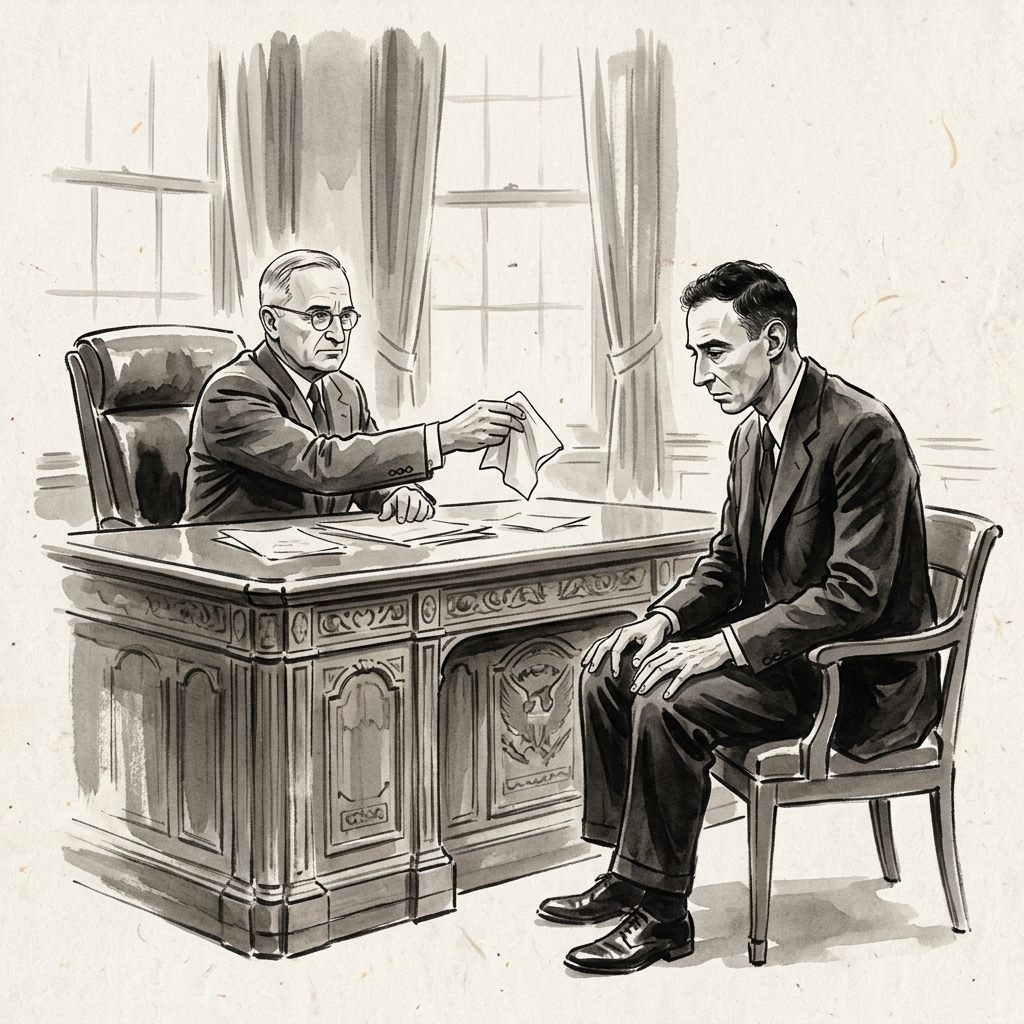
The one who built it feels the weight; the one who ordered it offers a handkerchief.
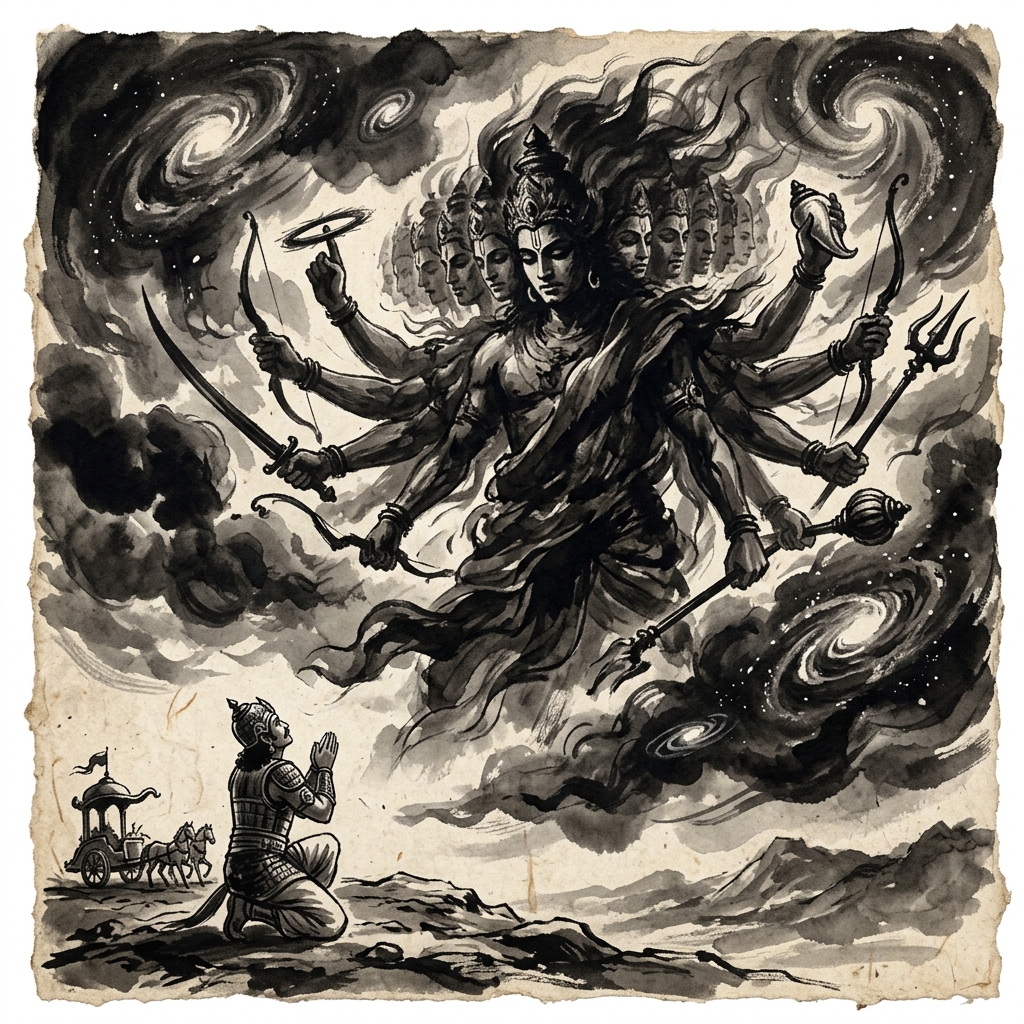
The cosmos shown to one man — so he will do what the field demands.
Truman's read is plausible only if you believe the work of the bomb ended when the trigger was pulled. Oppenheimer was operating on a longer arc. The act, for him, did not finish in August. It was still finishing in October, and would keep finishing for the rest of his life. To say he had blood on his hands was not a request for absolution; it was the kind of bookkeeping a man does when he has understood the entry he just made in the ledger.
II. The Verse He Reached For
When the Trinity device went off at Alamogordo three months earlier, Oppenheimer's mind, by his own later account, went to the eleventh chapter of the Bhagavad Gita. Now I am become Death, the destroyer of worlds. The line is usually quoted as a confession — a man identifying with his weapon. But the speaker of that line in the Gita is not the weapon. It is Krishna, in the moment he reveals his vishvarupa, his cosmic form, to Arjuna on the battlefield of Kurukshetra.
Arjuna is a warrior of the highest order, and he has just refused to fight. Across the field are his cousins, his teachers, the men who raised him. The dharma of the kshatriya tells him to draw his bow. The whole of human feeling tells him to drop it. He drops it. He sits down in the chariot and tells Krishna, his charioteer, that he would rather be killed unarmed than kill these men.
The Gita is the conversation that follows. Krishna's arguments are many — about the soul, about action without attachment to fruit, about the difference between renouncing the world and renouncing one's place in it — but none of them, on their own, move Arjuna. Argument is not what does it. What does it is the moment Krishna stops talking, and shows.
III. Catharsis as Scale
The virat roop is not a comfort. It is a vision of the cosmos as a single body, with all beings flowing into a vast, devouring mouth — including the warriors on both sides of Arjuna's field, including Arjuna himself. The destruction Arjuna is being asked to participate in is not authored by him. It is already underway. The choice is whether to be the instrument that aligns with it or the bystander that pretends it isn't happening.
The vision works where the argument did not. Argument tries to make the unbearable bearable. The vision does the opposite — it makes the unbearable visible at its true scale, and inside that scale, dharma becomes legible. Not because the cost has shrunk, but because the actor can finally see what he is acting on. The catharsis is not relief. It is perspective.
Arjuna picks up the bow. He does not pick it up because the killing has been justified to him. He picks it up because he has seen the field large enough to understand his place on it.
IV. The Two Mandates
Oppenheimer's mandate, as he understood it, was to keep the United States at the forefront of what he called "the technically sweet." The science would happen somewhere; the question was whether it happened first in a laboratory accountable to a constitutional democracy or in one that was not. He did not invent the physics. He did not start the war. He took the assignment that fell to him with the seriousness Arjuna eventually brought to his.
Truman had a mandate too, and it is unfair to cast him as the oblivious bystander. He ended a war that was killing people by the day, with the one instrument that promised to end it quickly. He could have played the victim of circumstance; he didn't. He decided, and carried the decision without theatre. That is also dharma — the assignment taken up and seen through.
V. The Verse, Read Correctly
So the source of the line matters. Now I am become Death is not a confession; it is Krishna's instruction. The verse is spoken to move Arjuna toward his mandate — to do the violent thing the field requires, having seen in full how violent it will be. The destruction is already underway. The only choice is whether to act as its instrument with open eyes, or to refuse and pretend it isn't happening.
The Gita never asks Arjuna to feel good about the war. It asks him to do his duty knowing the cost entire. Oppenheimer reached for the same verse because he was doing the same thing — the work gets done, and the one who does it does not get to keep his hands clean. The irony is not that one man carried a weight the other dismissed. It is that the line everyone quotes as guilt was always an exhortation to act.